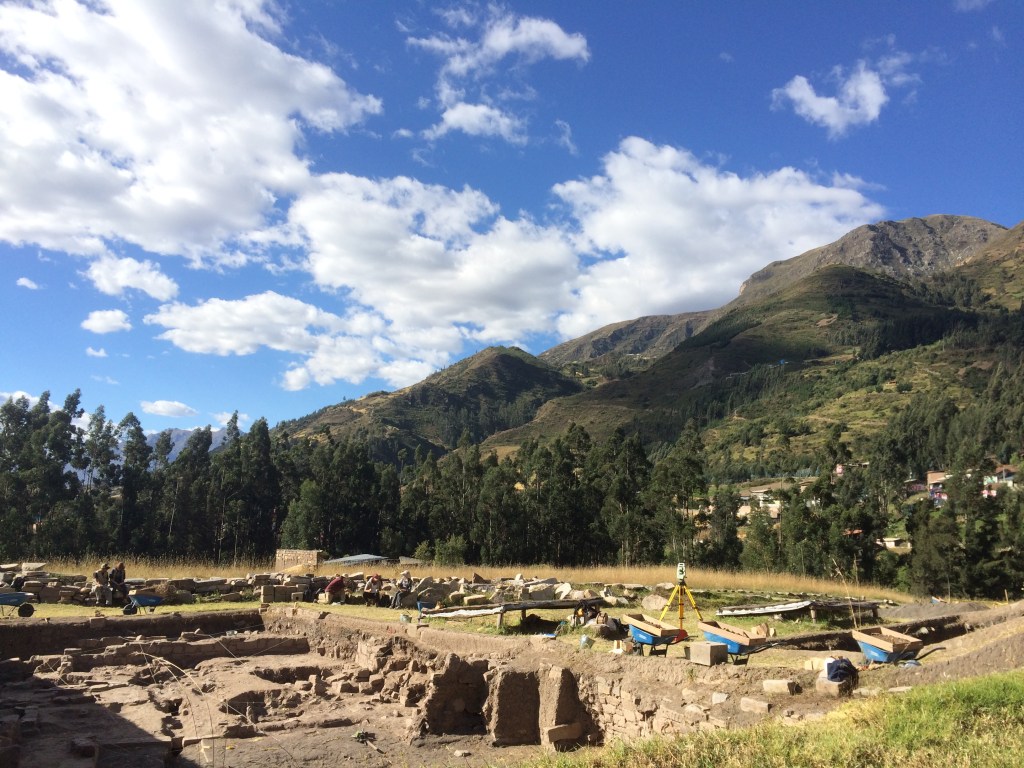
Our case- study discussion of 2018 fieldwork at Chavín builds on a decade of site- responsive archaeoacoustics research that has documented acoustical dynamics as well as perceptual and performance affordances of the extant architecture and site- excavated conch- shell horns (Strombus pututus) preserved since the mid- first-millennium BCE. The aural heritage fieldwork method we introduce here, “collaborative distributed sound- sensing,” employs both human observers and digital technologies to explore, document, mea sure, and map sound transmission and reception at Chavín, via reconstructive “performance auralizations” of archaeologically appropriate sound sources, Strombus shell replicas of the Chavín pututus.
Excerpt describing my pilot study:
The study “was meant to address questions about musical/ceremonial uses of Chavín’s Plaza Mayor. Could this space have been used for large- scale synchronized sonic activities (crowd clapping along with Chavín musicians, call- and- response singing, etc.) or would the timing of sequential echoes around the plaza architecture make it too difficult for people to accurately respond to auditory cues? What about conflicting auditory- visual cues? It is widely known that most people can coordinate clapping timing, at least when close to one another; trained musicians certainly can. To mimic the experience of musical synchronization between human performers, I created a testing scenario with a human “clapper” who provided the auditory- visual stimulus (clapping to a steady beat) with which to coordinate, and a participant “responder”who would try to synchronize their clapping with that of the clapper after a 10- clap demonstration for each stimulus. I created several different test scenarios, for different proximities of clapper and responder, separated by increasing distances across the plaza, and determined different tempos (speeds) of clapping. Coordinating with click tracks that I prepared for listening through an earbud, I served as the clapper, and several research team members with varying levels of musical training served as the responders. Each responder completed a set of twenty- four trials, differentiated by tempo, distance between clapper and responder, and clapper position.”
